
Golf strength training is the most reliably supported way to add clubhead speed. Across 25 intervention studies, golfers who completed strength and conditioning programs improved clubhead speed, ball speed, and distance by an average of 4% to 6.4% compared with golfers who kept practicing as usual. Those gains are not reserved for players in their 20s. In an older study of golfers around age 70, an eight-week functional training program that included resistance exercises moved average clubhead speed from roughly 79 to 83 mph. For Cary golfers between 40 and 70, the sharper question is how to build that speed without paying for it with your lower back.
Strength Training Is What Moves the Speed Needle
The strongest evidence comes from studies that handed golfers a structured strength program and compared them against golfers who did not train. A 2020 review in the Journal of Sports Sciences pooled 25 of those studies across mixed amateur and skilled golfers. Where the programs produced significant improvements, clubhead speed, ball speed, and driving distance rose by an average of 4% to 6.4%.
Read that as an average, not a forecast. Some golfers gained more, some gained less, and none of it replaces technique. What the review does establish is direction: training the body is a lever that shows up in ball flight, not just in how you feel walking off the 18th.
Age moves that number less than most players expect. In a study published in the Journal of Strength and Conditioning Research, 18 male golfers with a mean age of 70.7 completed an eight-week functional training program that included resistance exercises. Average clubhead speed went from roughly 79 to 83 mph, about a 5% improvement. It is an older study with a small sample, so treat it as encouraging rather than settled. It is also the clearest published answer to the question golfers in their 60s and 70s ask most: is it too late for this to work? The evidence says no.
"Just Stretch More" Is Not What the Research Supports
Flexibility has been the default golf fitness prescription for decades, and the data does not back it as the driver of speed. A 2024 meta-analysis in Sports Medicine pooled 20 studies to see which physical qualities actually track with clubhead speed. Lower-body strength correlated at r = 0.44 and upper-body strength at r = 0.45. Jump impulse, a measure of how much force a player can produce quickly, correlated at r = 0.68, the strongest relationship in the analysis. Flexibility on its own landed at r = -0.04, which is not statistically significant.
Correlation is not proof of cause, and mobility still earns its place in a program. If your mid-back will not rotate, you cannot get into a backswing position without borrowing range from somewhere else. The point is narrower than "stop stretching." It is that stretching alone has no measurable relationship with how fast the club is moving at impact, while strength and explosive power do.
Adding Speed Without Adding Back Trouble
Golf asks more of the body than its low-impact reputation suggests. A 2024 meta-analysis in the British Journal of Sports Medicine covering 20 studies and 9,221 golfers with a mean age of 46.8 found that 56.6% of amateur golfers sustain a golf-related musculoskeletal injury in their lifetime (95% CI 47.4 to 65.5). The lower back is a leading site. Professionals, who swing far more often at far higher speeds, carry roughly three times the lower-back injury risk of amateurs.
The mechanics are not mysterious. The swing builds rotation quickly and then has to stop it just as quickly. Hips, glutes, and mid-back are built to produce and absorb that force. When those areas contribute less, the movement has to come from somewhere, and the lower back is the most available substitute.
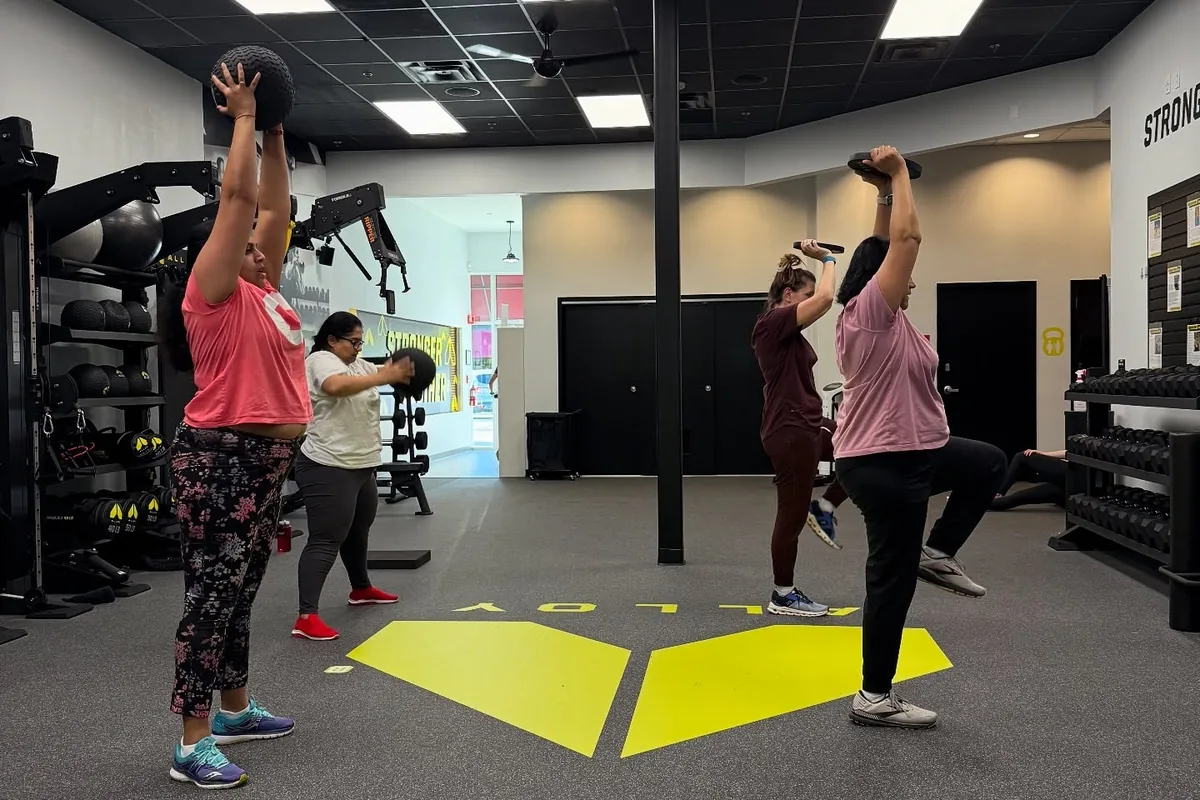
That is why a coached golf strength program spends its time on hip mobility and hip strength, glute work, rotational power, and anti-rotation core control. The goal is to give the swing more places to create speed and more places to decelerate it. Chasing speed by swinging harder through a body that cannot rotate well is the version of this that leaves golfers sore on Monday.
If you are dealing with back pain right now, talk to your doctor or a physical therapist before starting anything new. Coaching works alongside that care, not instead of it.
What a Golf Strength Program Actually Trains
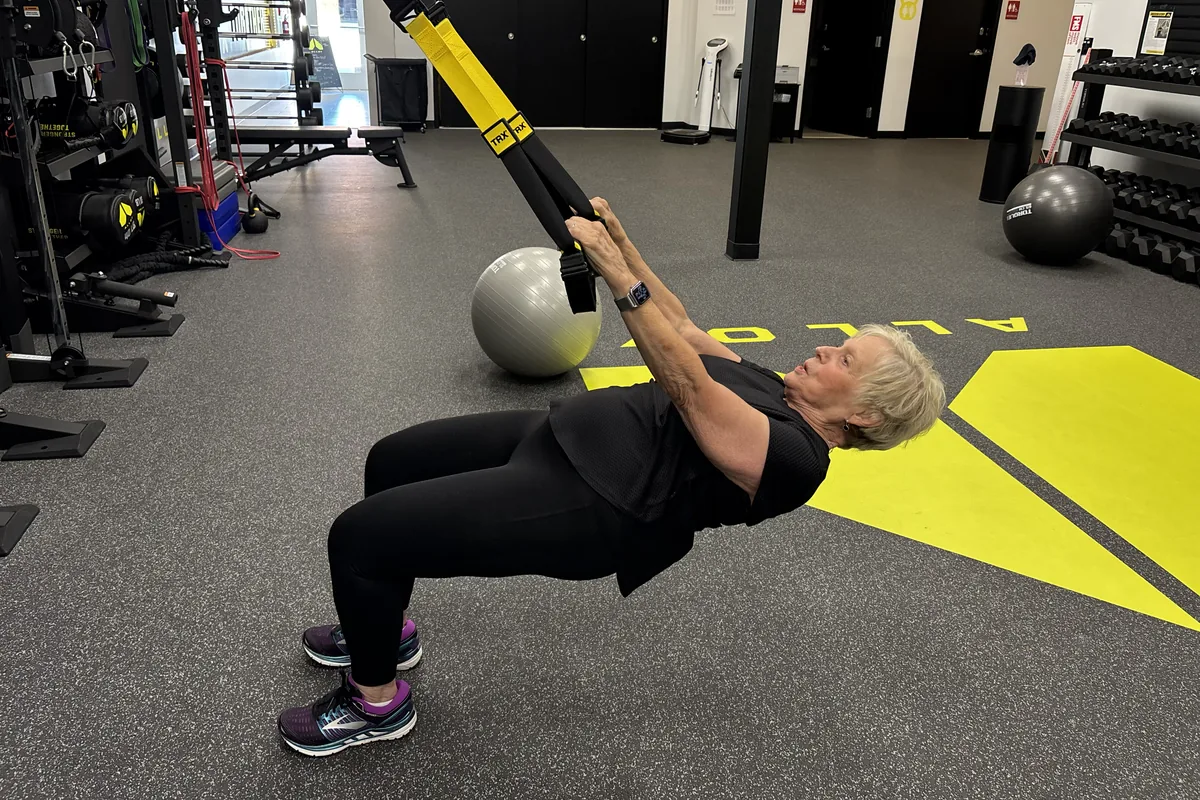
| Focus | Why it matters in the swing |
|---|---|
| Lower-body strength | The downswing starts against the ground; lower-body strength correlated with clubhead speed at r = 0.44 |
| Power and jump-type work | Jump impulse showed the strongest correlation with clubhead speed of any quality measured (r = 0.68) |
| Hip mobility and glute strength | The hips lead the downswing and take much of the load through the finish |
| Rotational power | Medicine ball throws train the body to move fast in the plane the swing lives in |
| Anti-rotation core control | Pallof presses and loaded carries train the trunk to resist rotation, which is how it stays organized at speed |
| Upper-body pulling and pressing | Upper-body strength correlated with clubhead speed at r = 0.45 |
| Single-leg balance and stability | Real rounds happen on sloped lies, and 18 holes is several miles of walking |
Notice what the list is built around: producing force and controlling it. The same framework applies to any sport built on rotating hard and stopping on a dime, which is why our approach to strength training for tennis players looks structurally similar even though the two sports feel nothing alike.
Signs Your Body, Not Your Swing, Is the Limiting Factor
Golfers usually take a distance problem to a swing coach first. That is often right. These are the patterns that suggest the fix is physical instead:
- Your distance has dropped steadily across several seasons while your ball striking held roughly steady
- Your lower back is stiff or achy the day after 18 holes, and it lingers into the next day
- Speed and accuracy fall off over the last four or five holes
- You cannot turn as far back as you used to, or your lead heel comes up to get you there
- Sloped and uneven lies feel less stable than they did five years ago
- You have started taking a cart on courses you used to walk comfortably
One or two of these is normal for any golfer past 40. Several of them together usually means the swing is being built on a foundation that has quietly narrowed. Some post-round stiffness is expected, and the line between ordinary training soreness and something worth a closer look is worth knowing; we cover it in what soreness after 40 actually means.
Cary Golf Skews Toward Players Over 50
The demographics of the game line up almost exactly with the adults we train. National Golf Foundation data shows 48.1 million Americans age 6 and up played golf in 2025, 29.1 million of them on course. Golfers 65 and older make up about 22% of on-course golfers and 27% of all golf spending. The people playing the most golf and investing the most in it are, on average, well past 50.
Cary's courses reflect that. Prestonwood Country Club runs 54 holes in the Preston community and hosts the SAS Championship, the PGA TOUR Champions event for professionals 50 and over. MacGregor Downs Country Club is the other private club in town. Lochmere Golf Club on Kildaire Farm Rd is semi-private, open for memberships and daily play.
It is a useful thing to have in your own backyard. Cary hosts a professional tour whose entry requirement is turning 50. Whatever your handicap, the premise that competitive golf ends at a certain birthday gets publicly tested at Prestonwood when the SAS Championship comes to Cary October 16-18, 2026.
How We Build Golf Strength Training Programs at Alloy Cary
The Titleist Performance Institute, which has certified more than 15,000 golf fitness and coaching professionals, frames it this way: there is no single correct way to swing a club, but there is "one efficient way for every player to swing and it is based on what the player can physically do." Training follows the body, not a template.
That is why every membership here starts with a functional movement assessment. Coaches look at how your hips, mid-back, shoulders, and ankles actually move before anyone picks up a weight. A golfer who cannot separate hips from shoulders needs different work than one whose rotation is fine but whose legs have gotten weak. Writing both of them the same program wastes the first six weeks.
From there, training runs in small groups of six or fewer, 50 minutes, coach-led start to finish. Everyone in the room follows their own program. Our strength training for adults over 40 approach is built on that structure: progressive loading, joint-by-joint attention, and a coach watching every set rather than writing a plan and walking away.
Most members notice improvements in energy and strength within the first few weeks. Body-composition change typically shows up over 8 to 12 weeks, which we track with monthly InBody scans so progress is measured rather than guessed at. Speed on the course follows the same rule as everything else in the research: it comes from consistency across months, not from one good session in March.
We serve golfers from Cary, Morrisville, Apex, Durham, and Raleigh out of our studio at Alston Town Center off NC-55 in west Cary. Preston is the closest of the three Cary golf communities to the front door.
See Where Your Swing Is Actually Being Limited
Spend one session finding out which part of your golf game is a physical problem and which part is a swing problem. Your first session includes a strength and mobility assessment, an InBody body-composition scan, a goal-setting conversation, and a customized fitness plan, with no obligations attached. Cary locals voted us Best New Business in Cary Magazine's 2026 Maggy Awards, and the coaching relationship behind that starts with this one conversation. Book your complimentary Starting Point Session and bring next season's golf with you.