Cary works at a desk. SAS has its main campus here, Epic Games is headquartered here, and a large share of town commutes to Research Triangle Park to sit in front of screens for eight or nine hours a day. That much sitting does not doom your spine, but it does leave specific things weak, stiff, and underused, and those are exactly the things strength training is good at fixing. Here is what a desk week does to a body, what the research supports, and what two coached sessions a week can change.
What a desk week actually does
Sitting itself is not an injury. The problem is the dose and the sameness: hips parked at ninety degrees, upper back rounded toward a monitor, shoulders rolled in, and almost nothing asked of your legs, glutes, or grip from Monday to Friday.
Over years, the pattern is predictable. Hip flexors and chest adapt to the shortened position. Glutes, hamstrings, and the muscles of the upper back spend forty-plus hours a week doing close to nothing. Strength you do not use declines, and after 30 that decline has a tailwind: adults lose muscle mass at a measurable rate each decade without training, with estimates in the range of 3 to 8 percent per decade.
The honest caveat: research has not shown that sitting posture by itself causes pain as directly as the internet suggests. Plenty of people with rounded shoulders feel fine, and plenty of people with perfect desk setups hurt. What the evidence does support is that stronger muscles tolerate more, recover faster, and complain less.
Why strength training, specifically
Walking helps, and Cary makes it easy with about 100 miles of greenways. But walking is aerobic work. It does almost nothing for the muscle-strengthening half of the federal activity guidelines, which call for muscle-strengthening activity at least two days a week on top of 150 minutes of moderate cardio. Fewer than one in four American adults meets both halves.
We covered the walking question in detail in Is Walking Enough Exercise After 50? The short version for desk workers: your lunchtime loop at Bond Park is genuinely good for you, and it does not load your muscles or bones enough to reverse what the chair is doing.
Strength training hits the gaps directly. Rows and pulls wake up the upper back that the monitor posture shuts off. Squats, hinges, and carries re-teach the hips and glutes to do their job. Grip work replaces what typing took away.
The desk worker pattern we see on the assessment floor
When someone who works a desk job comes through a functional movement assessment, the same findings show up again and again: limited hip extension, a stiff upper back that makes overhead work cranky, hamstrings that have lost range, and a squat that wants to become a forward lean.
None of that is a diagnosis, and none of it is permanent. It is just the starting condition, and it is why desk workers at our studio do not run some generic bodybuilding split. Personalized exercise programming means your first months are built around re-opening the positions your work week closes: more pulling than pushing, more hinge practice, more direct upper-back and glute work, mobility slotted where your body needs it.
What two 50-minute sessions a week change
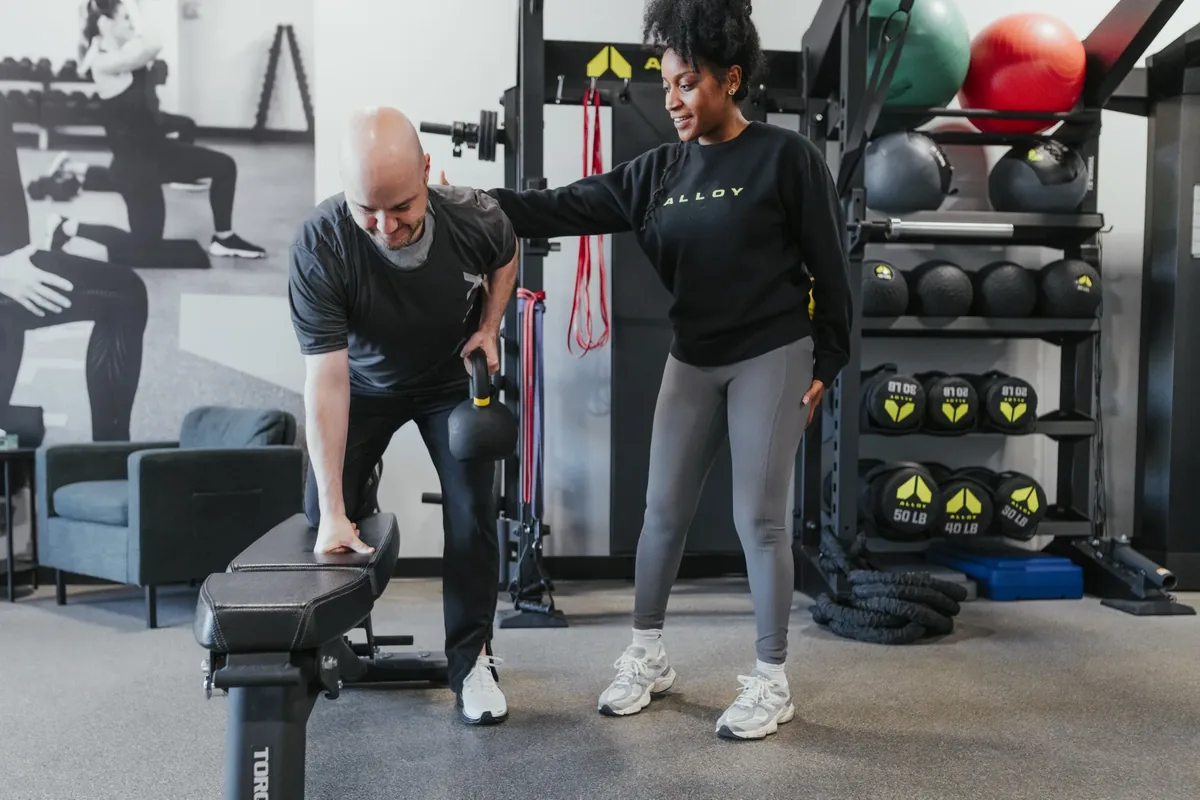
Our sessions run 50 minutes, coached, in groups capped at six. Two of those a week is the realistic floor for a busy work schedule, and it is enough to meet the strength half of the federal guideline with room to spare.
The early changes are the ones desk workers notice first: sitting through a 2 p.m. meeting without shifting around, carrying a car seat or a suitcase without bracing for it, standing up from the floor without a plan. Strength improvements show up in the first few weeks of consistent training. Visible changes usually follow over two to three months, which we laid out honestly in How Long Does It Take to Build Muscle After 40?
Fitting training around a Cary work week
The schedule is usually the real obstacle, so we built around it. Weekday sessions run in the early morning before the commute, midday, and in the evening after it. Saturday mornings cover the week that got away. Members commuting to RTP or working hybrid weeks tend to anchor one weekday session and one Saturday session, then add a third when the calendar allows.
The 50-minute cap matters here: the session starts and ends on time, the coach runs the plan, and you do not spend ten minutes deciding what to do next. You can be in at 6 and at your desk by 8 with time to spare.

Undo the week, twice a week
You do not need to quit your job or train like an athlete to undo what a desk week does. You need a program aimed at the right muscles, a coach watching your form, and two 50-minute slots that survive your calendar. A complimentary Starting Point Session is where that starts: an assessment, an InBody scan, and a plan built around your work week, with no obligations attached. Book yours here.