The research on exercise for brain health is genuinely promising and genuinely messy, and most articles only tell you the first half. The strongest recent evidence on strength training specifically comes from a 2025 meta-analysis of 17 randomized trials in adults 60 and over, which found improved working memory and improved overall cognition, but no significant effect on executive function, processing speed, or attention. An earlier meta-analysis found close to the opposite domain pattern. Below is what the studies report, who they studied, and what a reasonable person should do with that.
What the strength-training research actually found
Two major meta-analyses agree that resistance training improves overall cognitive scores in adults, and they disagree about which specific mental skills improve. That disagreement is rarely mentioned on the pages that rank for this topic, and it changes how confident anyone should be.
The newer analysis, Wu and Huang in Frontiers in Psychiatry (2025), pooled 17 randomized controlled trials covering 739 participants aged 60 and over, all without diagnosed cognitive impairment. Resistance training improved working memory (SMD 0.44, 95% CI 0.28 to 0.60, P<0.001, from 7 trials with 600 participants) and overall cognitive function (SMD 0.40, 95% CI 0.03 to 0.76, from 9 trials with 517 participants). It found no significant effect on executive function (4 trials), processing speed (5 trials), or attention (2 trials).
The earlier analysis, Landrigan and colleagues in Psychological Research (2020), pooled 24 studies in mixed adult samples and reported improvement in composite cognitive scores (SMD 0.71, 95% CI 0.30 to 1.12) and in executive function (SMD 0.39, 95% CI 0.04 to 0.74), but not in working memory (SMD 0.15, with a confidence interval crossing zero).
| Cognitive domain | Wu and Huang, 2025 (17 RCTs, 739 adults 60+, no cognitive impairment) | Landrigan et al., 2020 (24 studies, mixed adult samples) |
|---|---|---|
| Overall / composite cognition | Improved (SMD 0.40) | Improved (SMD 0.71) |
| Working memory | Improved (SMD 0.44) | No significant effect (SMD 0.15) |
| Executive function | No significant effect (4 trials) | Improved (SMD 0.39) |
Here is the honest read. The composite signal, that strength training tends to move overall cognitive scores in a favorable direction, shows up in both analyses. The domain-level claims are much shakier, because the 2020 analysis reported high heterogeneity across all its results, and each domain estimate in both papers rests on a handful of trials. Anyone who tells you strength training "sharpens executive function" or "boosts working memory" is picking whichever analysis agrees with them.
The SMART trial studied adults who already had mild cognitive impairment
The single most rigorous strength-training study on this question enrolled people who already had a diagnosis, which is the first thing most summaries leave out. The SMART trial, published in JAMDA in 2014, randomized 100 community-dwelling adults with mild cognitive impairment (mean age 70.1, ages 55 to 86, 68 women) in a double-blind, double-sham design over six months. Resistance training significantly improved the primary outcome, ADAS-Cog, compared with sham exercise, with a reported relative effect size of -0.33.
A 2017 follow-up analysis by Mavros and colleagues in the Journal of the American Geriatrics Society, using the same 100 participants, looked at what tracked with the cognitive change. Strength gains (upper body SMD 0.69, lower body SMD 0.94), not aerobic-capacity gains, were associated with cognitive improvement, and lower-body strength gains statistically mediated the improvement in ADAS-Cog and in the global domain, though not in the executive domain.
That is an interesting finding and it is one trial. Statistical mediation in a single study is a reason to keep studying something, not proof of how it works. And because every participant had mild cognitive impairment, SMART says very little about a healthy 45-year-old lifting twice a week in Cary. Memory changes that worry you are a conversation for your doctor, not something a training program should be asked to answer.
POINTER tested a whole program, not strength training alone
The most talked-about recent result in this space came from a multidomain program, so crediting it to strength work would be wrong. The U.S. POINTER trial, published in JAMA in 2025, followed roughly 2,100 at-risk, sedentary adults aged 60 to 79 for two years. Global cognition improved in both study arms. The structured program improved 0.029 standard deviations per year more than the self-guided arm (95% CI 0.008 to 0.050, P=0.008).
That structured arm included resistance training for 15 to 20 minutes twice weekly, plus aerobic exercise, the MIND diet, and cognitive training. There is no way to separate the strength component from the rest of it. Two details deserve more attention than they get: both groups improved, and the difference between them was small.
What POINTER does support is the combination approach that public health guidance has recommended for years, which is aerobic activity and muscle-strengthening work together rather than either alone. If you are currently doing the walking half and wondering whether that covers it, we worked through that question separately in is walking enough exercise after 50.
Where the evidence gets weaker
The strongest challenge to all of this came from researchers looking at the field's own methods. An umbrella review by Ciria and colleagues in Nature Human Behaviour (2023) re-examined 24 meta-analyses covering 109 randomized trials and 11,266 healthy participants. The pooled exercise-cognition benefit was d=0.22, which shrank to d=0.13 after adjusting for moderators and to d=0.05 after correcting for publication bias. The authors concluded that causal evidence for exercise improving cognition in healthy populations is weak.
That paper did not settle anything. A 2024 expert rebuttal in the same journal disputed both the methods and the conclusion, and the disagreement is still live. Reporting only one side of it would be the easy move, and it would be misleading.
The defensible bottom line: the case is strongest for adults 60 and over and for people already experiencing cognitive difficulty, where the trials were designed to detect change and found some. It is more modest, and more contested, for healthy adults, including healthy older adults, where the measured effects are small and may partly reflect which studies got published. That is a reason to train, since the other benefits of strength work are well established, and not a reason to expect your memory to change.
How much exercise for brain health the guidelines ask for
Read the guidance verbatim and the hedging is obvious, which is the point. WHO's 2019 guideline on risk reduction of cognitive decline and dementia states that "to reduce the risk of cognitive decline specifically, physical activity should be recommended to adults with normal cognition," classified as a strong recommendation on moderate-quality evidence. For adults with mild cognitive impairment, the same guideline says physical activity "may be recommended," a conditional recommendation on low-quality evidence.
WHO's second-edition guidelines, released in July 2026, carried the headline that "up to 45% of dementia risk could be prevented or delayed," and listed increasing physical activity among the recommended interventions. That figure is a population-level statement about modifiable risk factors across a whole society. It is not a number any individual can apply to themselves, and WHO does not single out strength training within it.
CDC's brain health guidance, reviewed in August 2025, is the most practical of the three. It states that "physical activity can help you think, learn, problem-solve," that "short bursts of physical activity can boost brain functions such as memory and thinking skills," and that "all adults also need muscle-strengthening activities two or more days a week."
What "two or more days a week" looks like at 55
Two coached strength sessions a week is the whole requirement, and most people overestimate what that means in practice. CDC's muscle-strengthening minimum is about loading the major muscle groups, not about hours in a gym or a particular style of training.
A single well-built session generally covers the same pattern set:
- A lower-body movement, usually a squat or hinge variation, scaled to what your hips, knees, and back tolerate
- An upper-body push and an upper-body pull
- Loaded carrying or trunk work
- Progressive loading, meaning the weight or difficulty moves up over time rather than staying flat
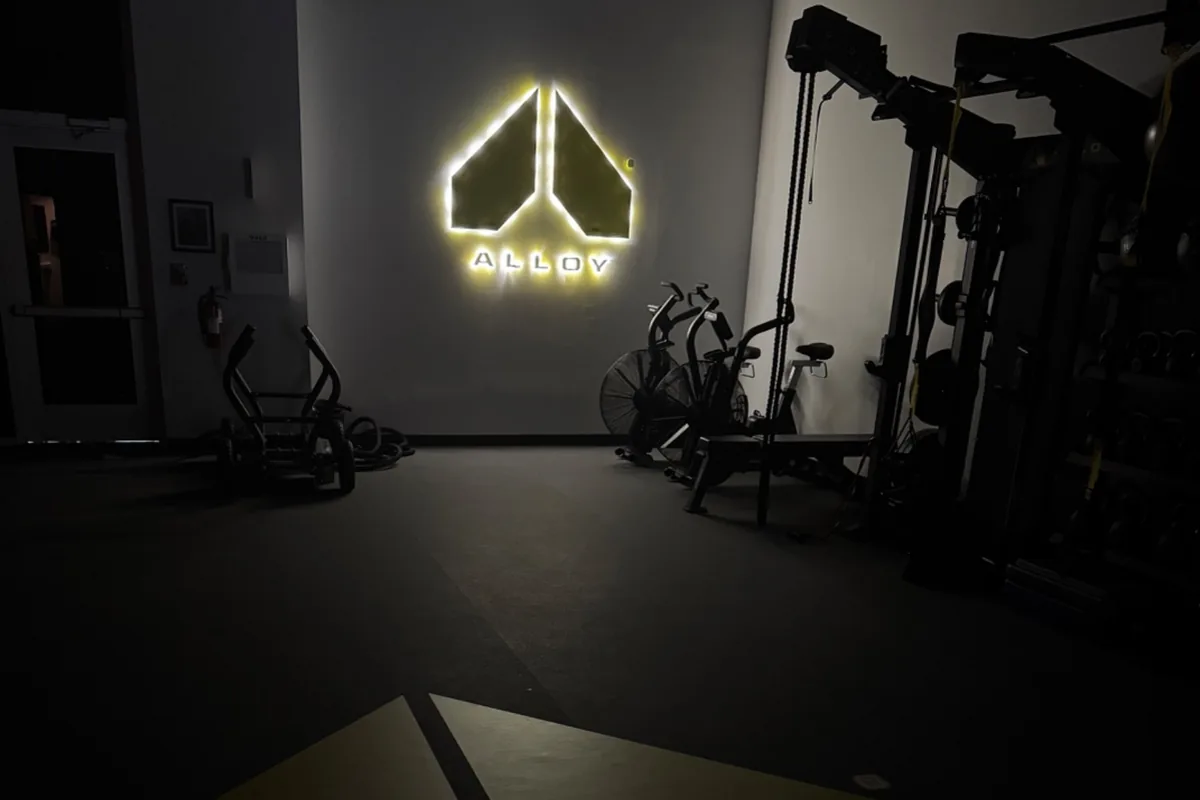
At our studio in Alston Town Center off NC-55 in west Cary, that translates to two 50-minute sessions a week. Sessions are coach-led start to finish and capped at six members, and every workout is individualized to the member's body, goals, and injury history. For a 55-year-old walking in with a cranky shoulder and a desk job, that individualization is the difference between two sessions a week being sustainable and being abandoned by week three. Our small group personal training model exists for exactly that reason, and our approach to strength training over 40 starts with a functional movement assessment rather than a template.
The harder part is not the programming. It is showing up in week nine and week twenty-six, which is why membership includes monthly accountability sessions alongside the training itself. Most members notice improvements in energy, strength, and confidence within the first few weeks, and body-composition change typically shows over 8 to 12 weeks. If you want the fuller timeline on the strength side, we covered it in how long it takes to build muscle after 40.
Frame the expectation correctly and the decision gets easier. Train because strength, balance, and independence are worth having in your 60s and 70s, and treat any cognitive benefit as a possible bonus that researchers are still arguing about.
Start With an Assessment, Not a Guess
If two strength sessions a week is the recommendation, the useful question is what those two sessions should contain for your body. Book your complimentary Starting Point Session and you will get a strength and mobility assessment, an InBody body-composition scan, a goal-setting conversation, and a customized fitness plan, with no obligations attached. We serve Cary, Morrisville, Apex, Durham, and Raleigh from Alston Town Center, and we were voted Best New Business in Cary Magazine's 2026 Maggy Awards. Book your complimentary Starting Point Session and we will build the plan around where you actually are.