
Small group personal training is individual coaching delivered in a small group. A coach is in the room the whole time, a few other people are training beside you, and you follow your own program, built around your body, your goals, and your injury history. At our Cary studio, sessions run 50 minutes and cap at six members, which is small enough for a coach to fix a hip hinge, drop a load, or swap a movement for anyone on the floor. It is not a class, and that distinction is the whole point.

How Small Group Personal Training Actually Works
Every member gets an individual program, and one coach runs several of those programs at the same time. Before your first working session, a coach takes you through a functional movement assessment and a goal-setting conversation, then writes a program around what your body can do right now. When you walk in, the coach already knows what you are lifting, how heavy, and what to change if your shoulder is unhappy that morning.
The group stays small deliberately. Our small group personal training sessions cap at six and are coach-led start to finish, which means nobody is left reading a workout off a screen and guessing. Six is the ceiling where a coach can still watch the quality of every set, not just the room's general energy.
This format is not fringe. The Health & Fitness Association's 2025 consumer report found that one third of fitness facility members (32.3%) took part in small-group training in 2024, and nearly one in four (22.6%) worked with a personal trainer, both described as historic highs for coaching engagement. That survey covered 18,000 US residents aged 6 and older. HFA's following report counted 81 million Americans holding a fitness facility membership in 2025, a 5.2% increase from 2024. More adults are training, and more of them are paying for a coach while they do it.
Small Group Personal Training vs. a Group Fitness Class
The two look similar from the doorway and work nothing alike. A group fitness class runs one workout for the whole room, set to music and paced by an instructor at the front. Small group personal training runs your program next to a few other people running theirs, with a coach moving between you to adjust loads, tempo, and movement selection in real time.
| Group fitness class | Small group personal training | |
|---|---|---|
| The workout | One workout for everyone | A program written for you |
| Group size | Often 20 to 40 people | Capped at six |
| Coach's role | Leads and demonstrates from the front | Coaches each person individually |
| Progression | The same for the whole room | Tracked and advanced per member |
| Injury history | You modify on your own | Built into your program |
That difference matters most for adults past 30, who tend to arrive with some history: an old ACL, a rotator cuff that clicks, fifteen years at a desk. In a class, the modification is your job. In small group personal training, the modification is the coach's job, and it is written into the program before you get there.
Inside a 50-Minute Session With a Cap of Six
The session has a predictable shape, and the coach is working the entire time. Here is how it runs on the floor.
The first few minutes. The coach greets each member, asks how the last session felt, and checks in on sleep, soreness, and anything that changed since last week. Those answers change the session. A member who slept four hours the night before does not get their planned heavy day.
Warm-up. The group moves through general movement prep together, with individual tweaks. One person gets extra thoracic spine work, another gets ankle mobility before squatting.
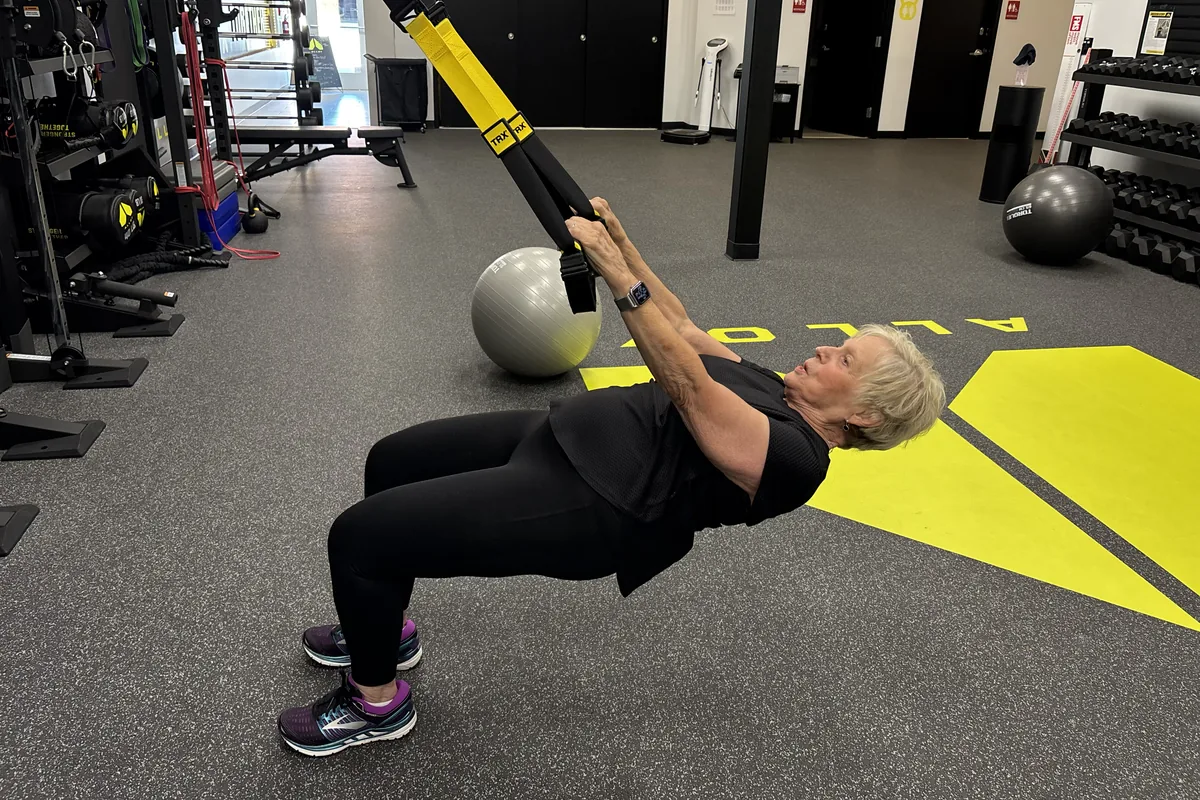
The working block. This is the bulk of the 50 minutes, and it is where six people run six different programs without colliding. The coach sequences the order of exercises rather than the exercises themselves, so two members never need the same rack at the same minute. One member is on trap bar deadlifts while another does a landmine press because overhead pressing aggravates her shoulder, while a third works through split squats at a load that went up since last month. The coach rotates continuously, cueing setup, correcting a rounding back, calling for more weight when a set looked easy. Personalized exercise programming is what makes this possible: the programs are written in advance to be run side by side.
The last few minutes. Cooldown and mobility work, then the coach logs your loads and tells you what is coming next session. You leave knowing what you lifted and why.
Where the InBody Scan and Monthly Check-Ins Fit
The training floor is only part of the format. Membership includes a monthly InBody body-composition scan, a monthly accountability session, and ongoing nutrition coaching rather than a one-time conversation at signup. The scan takes about a minute and reports muscle mass, body fat, and segmental balance, which gives the coach something more useful than the bathroom scale when deciding what to change in your program.
The monthly accountability session is where that data turns into decisions. You sit down with your coach, look at the trend, talk about what actually happened in the last four weeks, and adjust the plan. Sometimes the adjustment is programming. Often it is scheduling, because two sessions a week you keep beat three you skip.
On timelines, we try to be honest. Most members notice improvements in energy, strength, and confidence within the first few weeks. Body-composition change typically shows up over 8 to 12 weeks, which is why the scan cadence is monthly rather than weekly. Long-term results come from consistency, and the check-in exists to protect consistency.
What the Research Says About Having a Coach in the Room
Supervision is the variable with the most evidence behind it. In a 2025 randomized trial published in the Journal of Strength and Conditioning Research, 79 trained men and women (mean age 30.7) were assigned to 10 weeks of resistance training that was either supervised in person, guided by an app, or self-directed. Adherence came in at 88.2% for the supervised group, 81.2% for the app-guided group, and 52.2% for the self-guided group. The supervised group also showed greater improvements in squat and bench strength. Worth noting: these were already-trained lifters, not beginners.
Older work points the same direction. A 2022 meta-analysis by Fisher and colleagues pooled 12 randomized trials covering more than 500 participants and found a small positive effect of supervised resistance training on strength compared with unsupervised training, with a standardized effect size of 0.40. Back in 2000, Mazzetti and colleagues ran 20 moderately trained men through 12 weeks of either directly supervised or unsupervised training in Medicine & Science in Sports & Exercise; the supervised group finished with significantly greater maximal squat strength and progressed their training loads significantly faster through the middle of the program.
Sticking with it is the other half of the story. A 7-year study of small-group studio members published in Frontiers in Public Health in 2026 tracked 587 adults aged 40 to 85 training in supervised groups of no more than five. At 12 months, 51.7% were still attending, against the 3.7% to 37% one-year retention the authors cite as typical for conventional gyms, with mean participation of 13.8 months. That cohort was a single studio, skewed older and 73% female, so it is not a direct read on any one person. It is still a useful signal that supervised small groups hold people longer than a keycard and good intentions do.
How the Cost Compares With One-on-One Training
Small group costs less per session than one-on-one because the coach's time is shared. For an anchor, Thumbtack's national cost guide puts personal trainers at $40 to $100 per hour, with an average of $55 per hour, based on quotes from marketplace pros as of late 2025. Add two or three sessions a week to that rate and one-on-one becomes a real line item in a household budget.
Splitting a coach's attention across a small group changes the math. You are not buying a slice of a 30-person class, and you are not buying a coach's undivided hour. You are buying individual programming plus a coach who is watching you for a meaningful share of 50 minutes, at a fraction of what undivided time costs. Published per-session numbers for small group training float around the internet without much methodology behind them, so we would rather describe the structure than quote someone else's guess. For a fuller breakdown of what training costs look like around here, see our post on personal trainer cost in Cary, NC.
Who Group Personal Training in Cary, NC Tends to Fit
The format suits people who want results without having to become their own coach. Cary skews that way: median age 43, and 69.4% of adults 25 and older hold a bachelor's degree or higher, roughly twice the national rate, in one of the Triangle's largest and most affluent towns, according to Census Bureau American Community Survey data. That is a population with demanding jobs, limited hours, and a low tolerance for approaches that are not backed by anything.
In practice, our members are adults 30 and up who have either tried the big-box gym and drifted, or worked with a trainer one-on-one and found the cost hard to sustain three times a week. They want someone accountable for the plan.
We are at 5022 Arco St in Alston Town Center, off NC-55 in west Cary, and we train members from Cary, Morrisville, Apex, Durham, and Raleigh. If you are searching small group training near me and comparing options, the questions worth asking are how many people are in a session, who writes the program, and what happens between sessions. Our post on choosing a gym in Cary, NC walks through the rest of that checklist, and a Starting Point Session is the easiest way to see the format for yourself before committing to anything.
See the Format Before You Commit
The simplest way to understand small group personal training is to be coached through it once. Your complimentary Starting Point Session includes a strength and mobility assessment, an InBody body-composition scan, a goal-setting conversation, and a customized fitness plan you can keep, with no obligations attached. We opened in Cary in 2025 and were voted Best New Business in Cary Magazine's 2026 Maggy Awards, with more than 12,000 locals voting. Book your complimentary Starting Point Session and meet the coach who would be writing your program.